DeepVest Logo
DeepVest
Back to Articles
Advisor Insights

Can a 58-Year-Old With $2.4M Retire Today? The RIA Framework for Answering in One Meeting

DeepVest turns the hardest retirement question into a clear review of income, taxes, risk, spending, and sequence-of-return pressure.

By Amit Nar, Head of Client Success


Every advisor has heard some version of this question:

“Can I retire now?”

For a registered investment advisor, this question isn’t just about assets. It’s about spending, taxes, healthcare, Social Security, market timing, risk tolerance, behavior, and family goals.

One number can make the client feel safe. The wrong number can create false confidence, which is why retirement-readiness conversations need more than a rule of thumb. A 4% withdrawal rule or a Monte Carlo score can be useful, but they’re not enough. The advisor needs a client-ready framework.

Using DeepVest, a broad retirement question like this becomes a structured analysis an advisor can review, refine, and explain in one meeting.

We Asked DeepVest AgentLab

We posed the following question to DeepVest AgentLab:

“I am a Registered Investment Advisor preparing for a client meeting. A 58-year-old client with $2.4M in investable assets asks, ‘Can I retire today?’ Use the synthetic client case below to build a concise retirement-readiness analysis with specific numbers: annual spending capacity, sustainable withdrawal rate, income gap, tax risks, healthcare/Medicare bridge risk, sequence-of-return risk, portfolio drawdown risk, and probability-style scenarios if possible.
Create an advisor-ready answer with: the top 5 issues to review, estimated dollar impact where possible, a table ranking each issue by urgency, key questions the advisor must ask before making a recommendation, and a simple client-ready explanation that is clear, professional, and not investment advice.”

We gave AgentLab a detailed synthetic client case to work from:

  • Household: a 58-year-old client and a 56-year-old spouse, married, who want to retire immediately with $2,400,000 in investable assets.
  • Accounts: $950,000 in a taxable brokerage, $1,050,000 in a traditional IRA and 401(k), $250,000 in a Roth IRA, and $150,000 in cash.
  • Allocation: 58% U.S. equities, 12% international equities, 20% bonds, and 10% cash.
  • Cost basis and taxes: a $720,000 cost basis on the $950,000 taxable account, about $230,000 of embedded unrealized gain, and a blended long-term capital gains rate near 23.8%.
  • Spending: $135,000 of desired after-tax spending, roughly $165,000 gross, with a 3.0% inflation assumption.
  • Income: a $275,000 current salary, no spouse income or pension, and Social Security of $42,000 for the client and $24,000 for the spouse at age 67, rising to $52,000 and $31,000 at age 70.
  • Healthcare: about $24,000 per year in private premiums and out-of-pocket costs until Medicare begins at 65.
  • Home and debt: an $850,000 home with a $180,000 mortgage ($2,400 per month, 8 years left), an $18,000 auto loan, and no credit card or student debt.
  • Risk profile: moderate, comfortable with a 15% drawdown but likely to panic past 20%.
  • Goals: retire now if realistic, keep the current lifestyle, budget $20,000 a year for travel in the first 10 years, leave at least $1,000,000 to the children, avoid running out of money, and reduce taxes where possible.
  • Planning assumptions: life expectancy of 92 for the client and 94 for the spouse; a 5.5% base-case return, 3.5% bear case, and 7.0% strong case; and a sequence-of-return stress test of a 20% portfolio decline in year one.

AgentLab’s Response
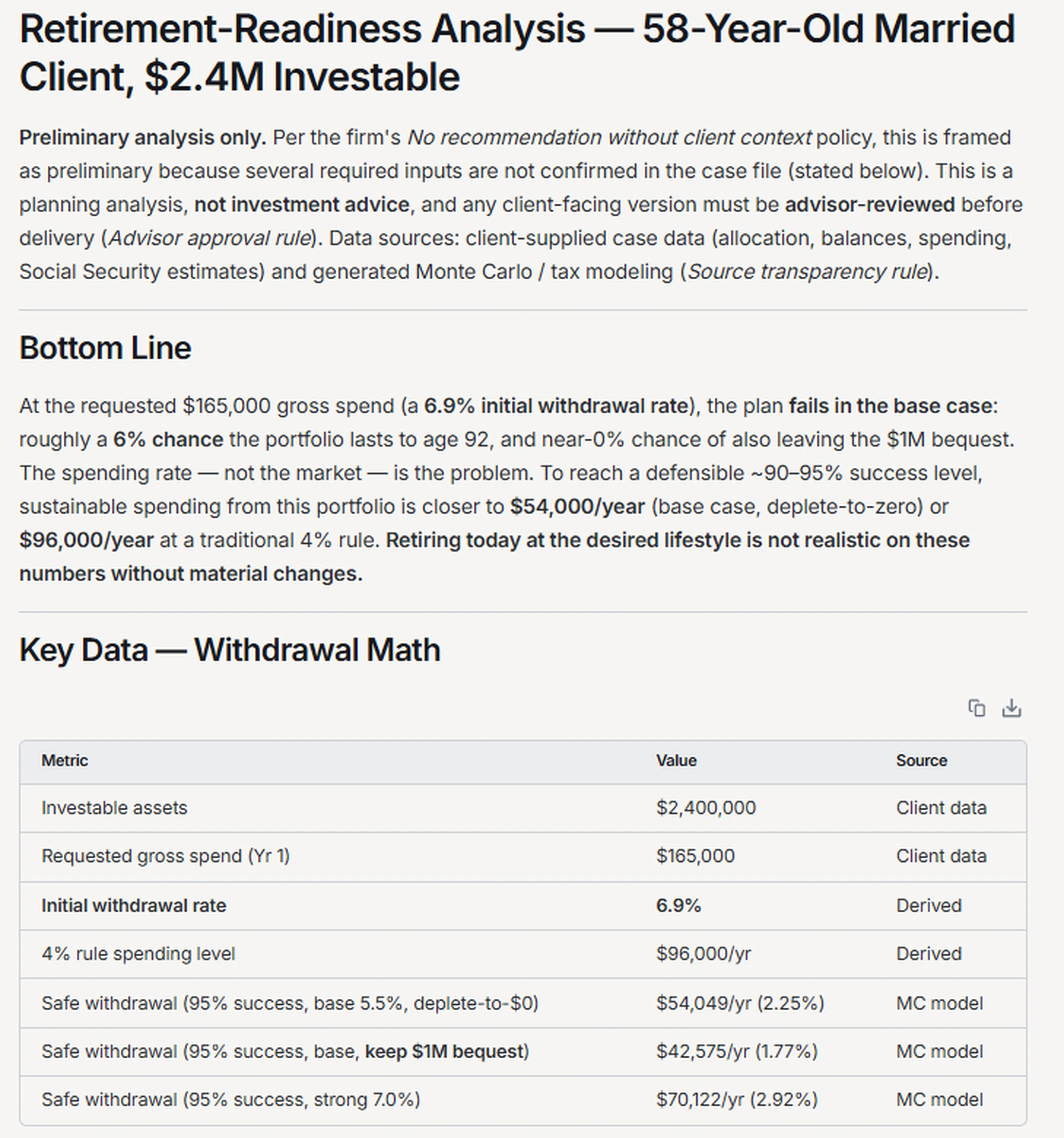
DeepVest AgentLab retirement-readiness analysis for a 58-year-old married client with $2.4M investable. A preliminary-analysis note and a Bottom Line explain that at the requested $165,000 gross spend, a 6.9% initial withdrawal rate, the plan fails in the base case, with roughly a 6% chance the portfolio lasts to age 92. Sustainable spending is closer to $54,000 per year depleting to zero, or $96,000 per year at a 4% rule. A Key Data withdrawal-math table lists investable assets of $2,400,000, a requested gross spend of $165,000, the 6.9% initial withdrawal rate, and safe-withdrawal levels of $54,049, $42,575 while keeping a $1M bequest, and $70,122 per year.
AgentLab opens with source transparency and a clear bottom line: at a 6.9% withdrawal rate the plan fails in the base case. Sustainable spending is closer to $54,000 per year, or $96,000 at a 4% rule.
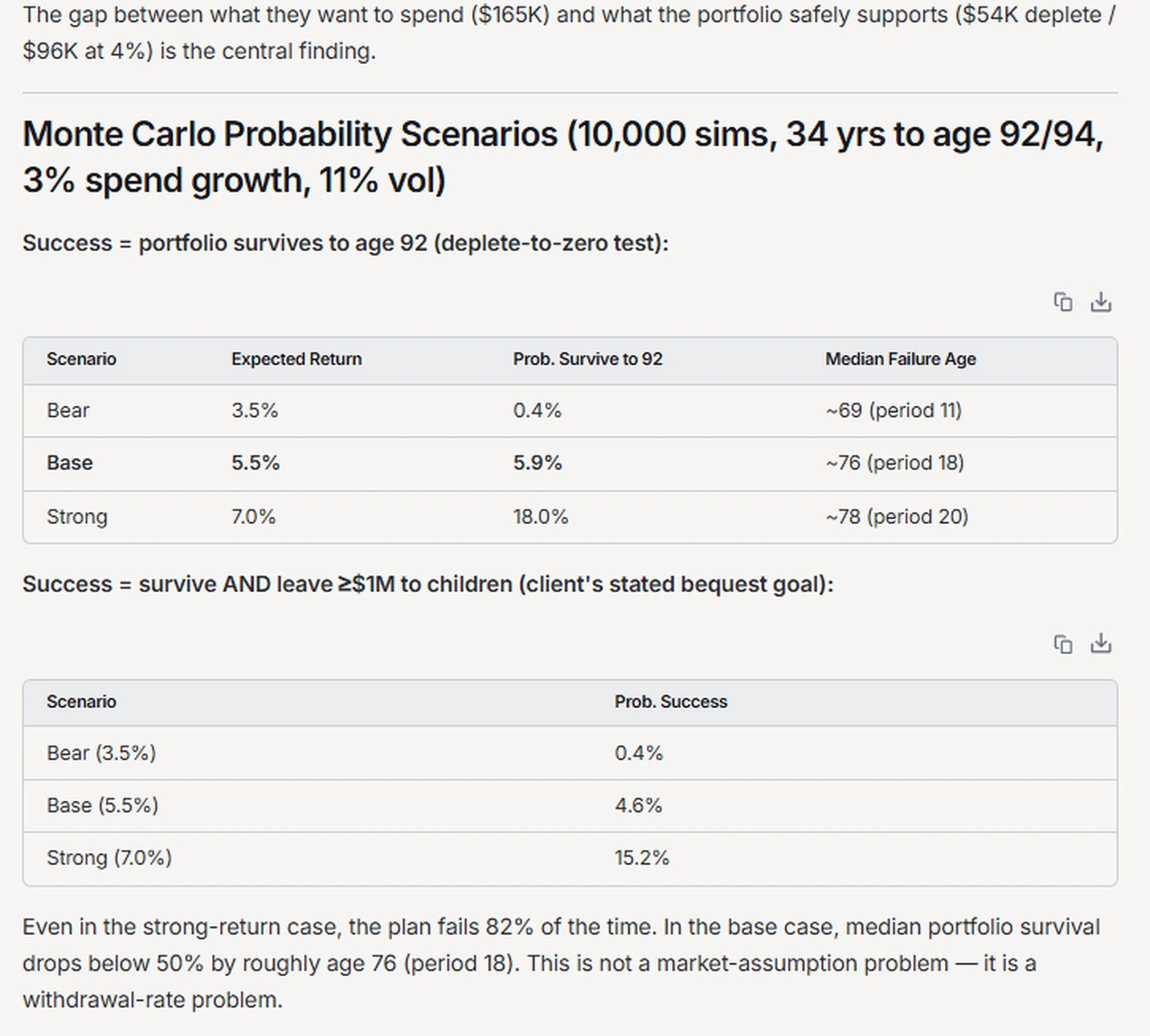
Monte Carlo probability scenarios from 10,000 simulations over 34 years to age 92 and 94. A survive-to-92 table shows a 0.4% success rate in the bear case at a 3.5% return, 5.9% in the base case at 5.5%, and 18.0% in the strong case at 7.0%, with median failure ages near 69, 76, and 78. A second table for surviving and leaving at least $1M to children shows 0.4%, 4.6%, and 15.2% success across the same scenarios.
Monte Carlo survival odds. Even the strong-return case fails 82% of the time, which points to a withdrawal-rate problem rather than a market-assumption problem.
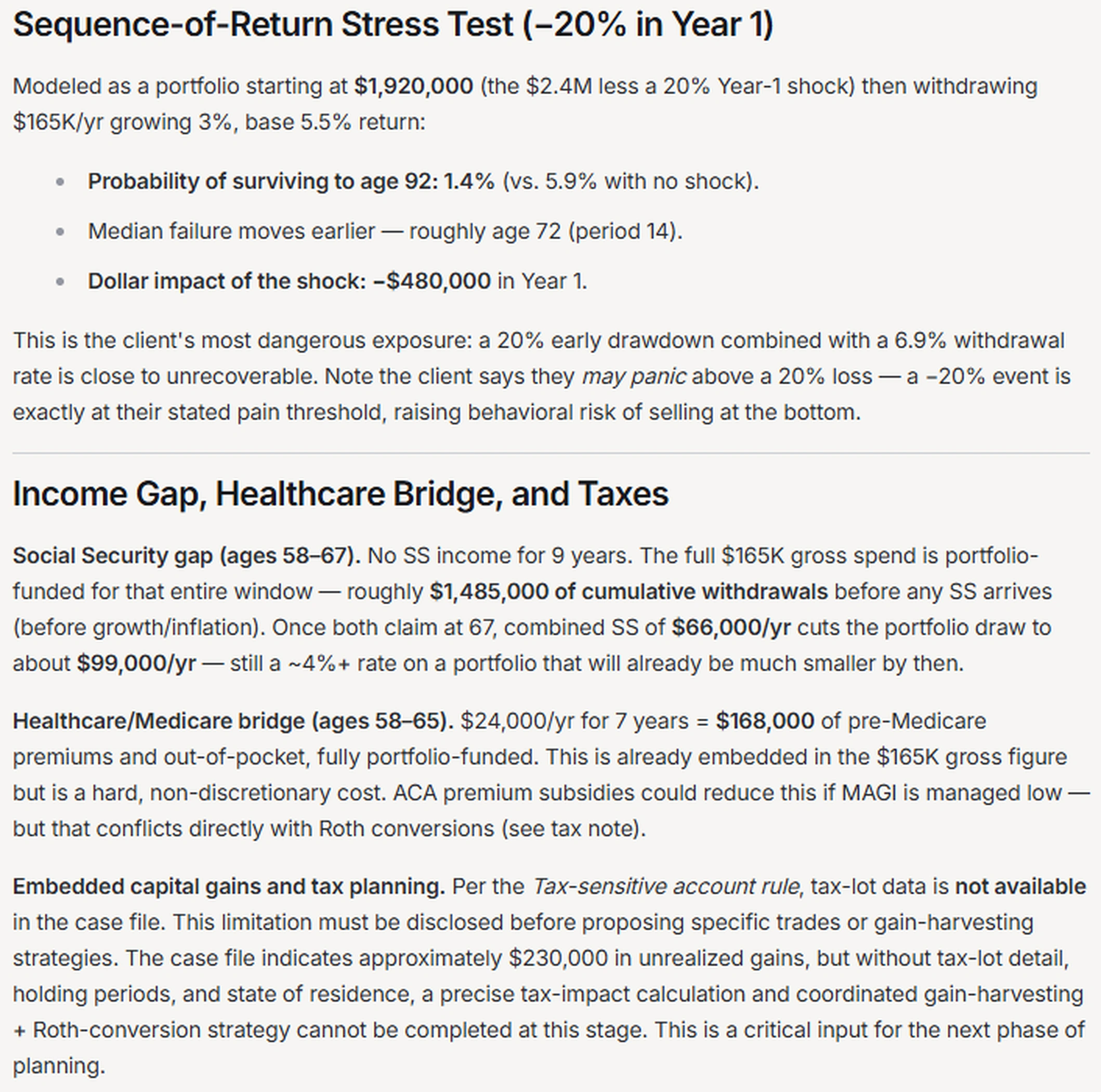
A sequence-of-return stress test modeling a 20% portfolio decline in year one, starting at $1,920,000 and withdrawing $165,000 per year. The probability of surviving to age 92 falls to 1.4%, versus 5.9% with no shock, median failure moves earlier to about age 72, and the year-one dollar impact is roughly $480,000. An income section covers a nine-year Social Security gap of about $1,485,000 in cumulative withdrawals before Social Security begins, a $168,000 pre-Medicare healthcare bridge from ages 58 to 65, and roughly $230,000 of embedded capital gains that cannot be fully modeled without tax-lot data.
A 20% first-year shock on top of a 6.9% withdrawal rate cuts survival odds to 1.4%. The nine-year gap before Social Security and the pre-Medicare healthcare bridge front-load the risk.
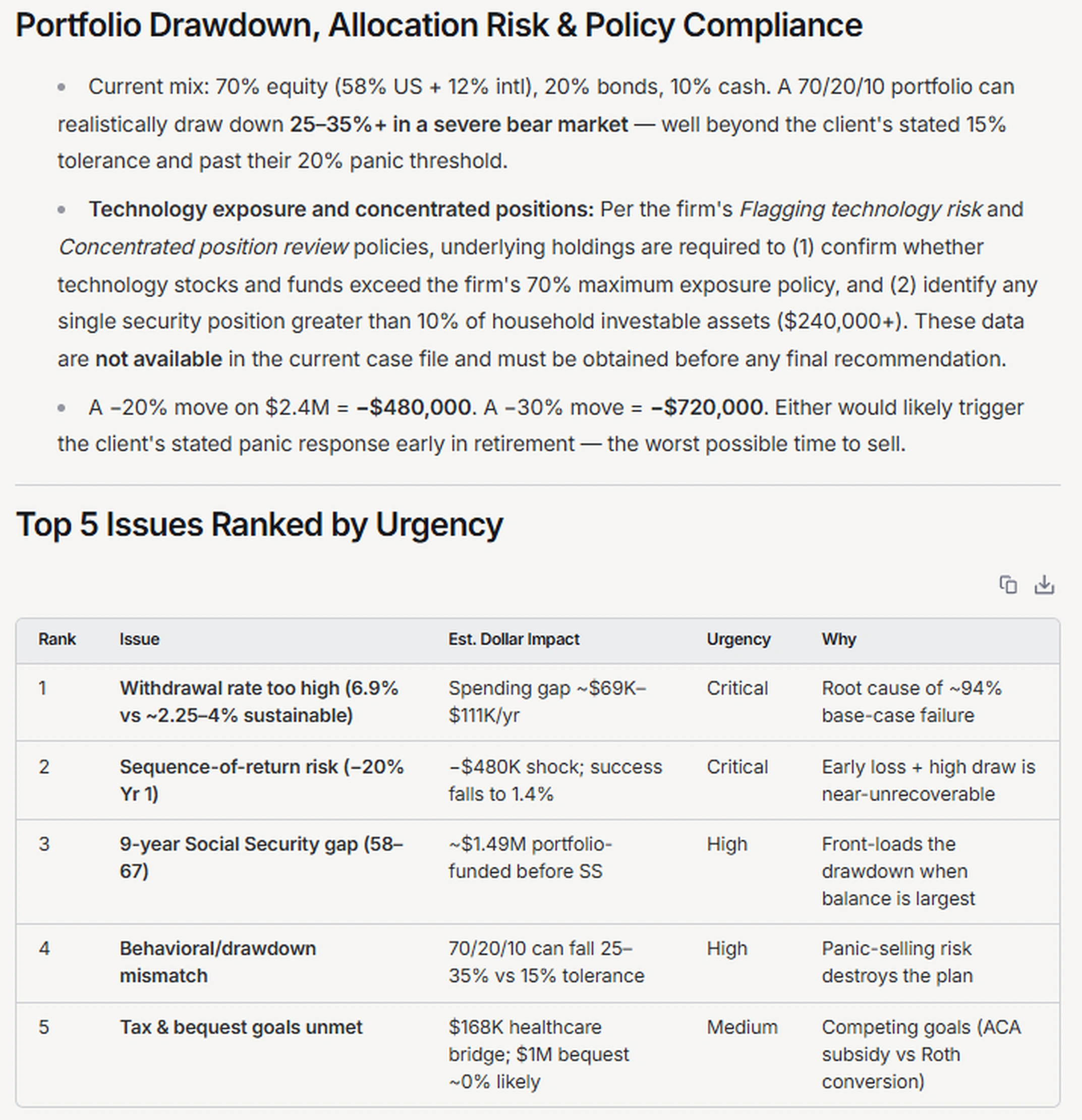
A portfolio drawdown and allocation-risk section noting that the 70/20/10 mix of 58% U.S. and 12% international equity, 20% bonds, and 10% cash could realistically fall 25% to 35% or more in a severe bear market, well beyond the client’s 15% tolerance and 20% panic threshold. A 20% move on $2.4M equals about $480,000 and a 30% move about $720,000. A Top 5 Issues table ranks the risks by urgency: withdrawal rate too high and sequence-of-return risk are both Critical, the nine-year Social Security gap and a behavioral drawdown mismatch are High, and unmet tax and bequest goals are Medium.
The top five issues ranked by urgency, with estimated dollar impact. Both Critical issues, an over-high withdrawal rate and sequence-of-return risk, trace back to spending rather than markets.
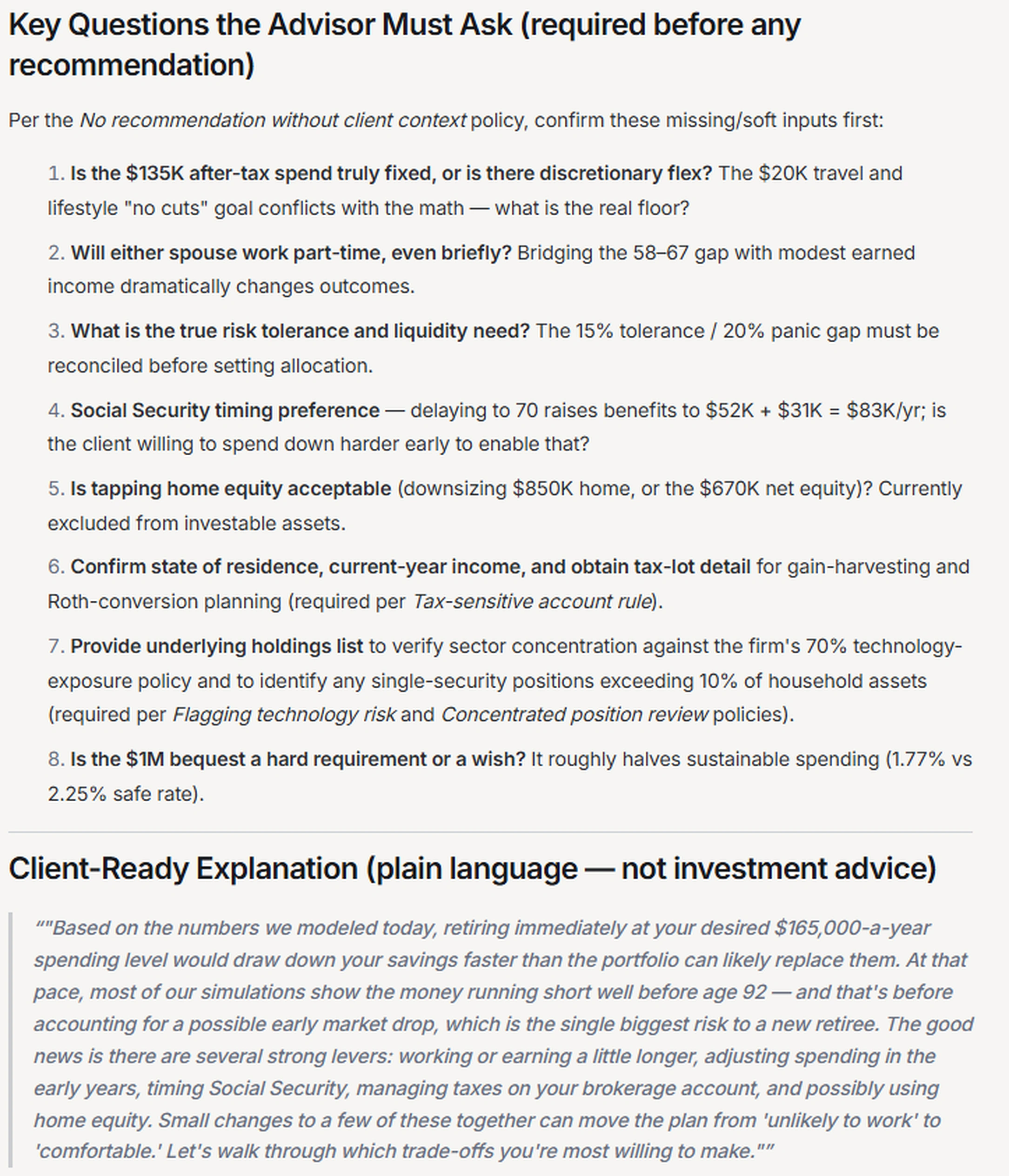
A list of eight key questions the advisor must ask before making any recommendation, including whether the $135,000 after-tax spend is truly fixed, whether either spouse would work part-time, the client’s true risk tolerance and liquidity needs, Social Security timing, whether tapping home equity is acceptable, state of residence and tax-lot detail, the underlying holdings list, and whether the $1M bequest is a hard requirement or a wish. A client-ready explanation in plain language follows, describing in non-advice terms why retiring immediately at the desired spending level would draw down savings too quickly, and which levers could move the plan from unlikely to comfortable.
The questions an advisor still needs to ask, plus a plain-language, client-ready explanation that reframes the answer around trade-offs the client can control.
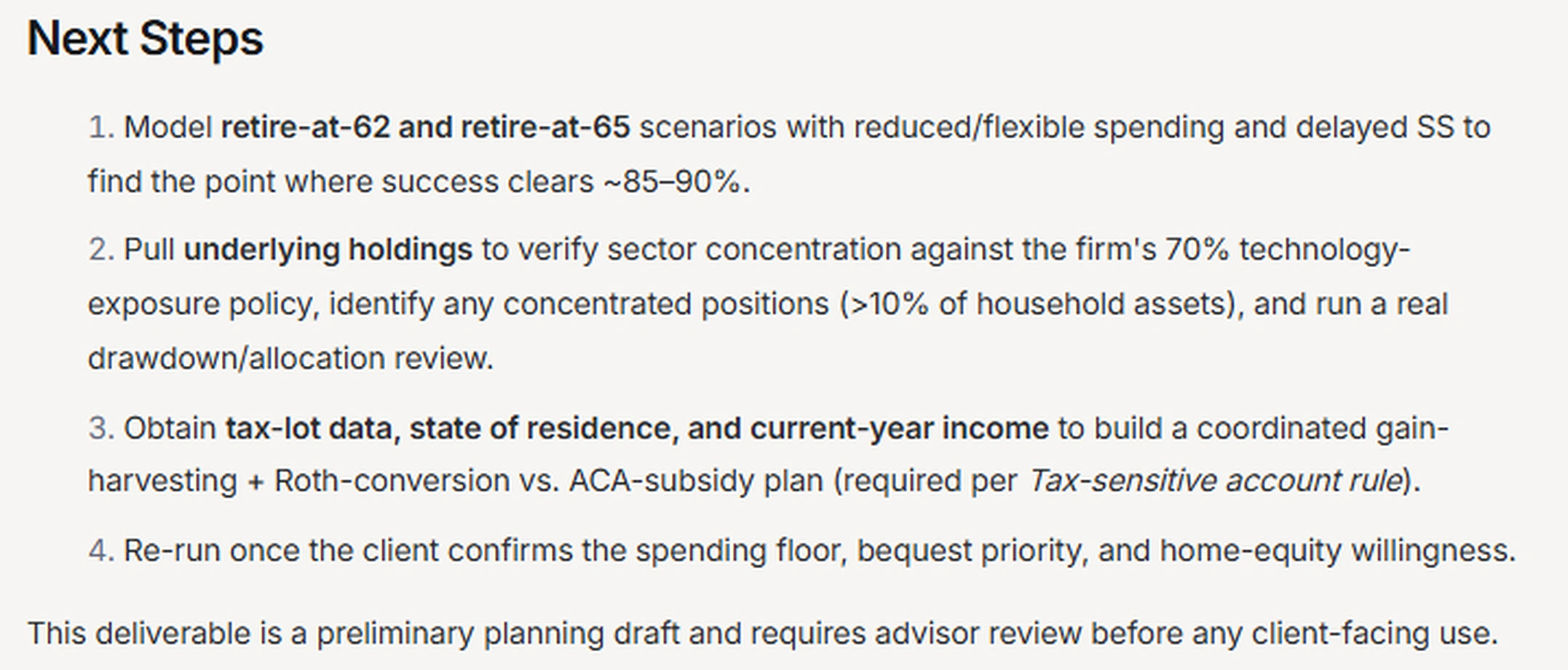
A Next Steps list recommending the advisor model retire-at-62 and retire-at-65 scenarios with reduced or flexible spending and delayed Social Security to find where success clears roughly 85% to 90%, pull the underlying holdings to verify sector concentration and check for concentrated positions, obtain tax-lot data, state of residence, and current-year income to build a coordinated gain-harvesting and Roth-conversion plan, and re-run the analysis once the client confirms the spending floor, bequest priority, and willingness to use home equity. A closing note states the deliverable is a preliminary planning draft that requires advisor review before any client-facing use.
Clear next steps. The analysis ends by naming the exact scenarios and data an advisor should confirm before turning it into advice.

Why This Matters for RIAs

The client wants a yes-or-no answer, but the advisor needs a real answer.

Manually, this can take hours. The advisor may need to rebuild the household balance sheet, estimate spending, model healthcare costs, test Social Security timing, calculate withdrawal rates, run sequence-risk scenarios, review tax trade-offs, and still translate the result into language the client can understand.

DeepVest compresses that work into a practical advisor workflow by:

  • Identifying the key number: a 6.9% withdrawal rate.
  • Quantifying the risk: only 5.9% base-case survival.
  • Showing the shock: a 20% first-year decline cuts survival to 1.4%.
  • Giving the advisor the meeting language.

The client gets a real answer. The advisor gets there in one meeting, not three weeks.

Schedule a demo with DeepVest to see how DeepVest helps RIAs run portfolio audits, identify hidden risks, and turn complex analysis into client-ready conversations.

Advisor Takeaway

The best advisors don’t answer retirement questions with hope. They answer with structure.

A client with $2.4 million may feel wealthy. But if the spending rate is too high, the plan can still fail.

DeepVest helps RIAs turn that lesson into a clear conversation: what works, what doesn’t, what needs to change, and what questions need to be answered before any recommendation.

This is the difference between answering a client and preparing an advisor.

Schedule a demo with DeepVest to see how DeepVest helps RIAs run portfolio audits, identify hidden risks, and turn complex analysis into client-ready conversations.

For questions, contact: [email protected].

Disclaimer: This content is for informational and educational purposes only and does not constitute investment, financial, or professional advice. Views expressed are those of the author and do not necessarily reflect DeepVest’s official position. DeepVest is a technology platform providing analytical tools—not a registered investment advisor, broker-dealer, or financial institution. Our tools are designed to support the independent judgment of financial professionals, not replace it. Nothing herein constitutes a recommendation to buy, sell, or hold any security or adopt any investment strategy. Portfolio analyses and examples are illustrative only and do not represent actual outcomes or guarantee future results. Consult qualified financial, legal, and tax professionals before making investment decisions. DeepVest disclaims all liability for decisions made in reliance on this content.


DeepVest LogoDeepVest

AI-powered portfolio intelligence for financial advisors. Institutional-grade analysis, zero hallucinations, fully auditable.

    Can a 58-Year-Old With $2.4M Retire Today? The RIA Framework for Answering in One Meeting | DeepVest